
Fuel cell technology offers a quiet data center power solution.
FuelCell Energy’s carbonate fuel cell systems are significantly quieter than traditional data center power technologies. This is because fuel cells generate electricity through an electrochemical reaction, not combustion or rotating machinery. The fuel cell system’s sound levels are approximately 62 dBA at 30 feet, about the same volume as a residential HVAC system, making them well suited for urban, campus, and community-adjacent environments.
Why are carbonate fuel cells quieter than engines or turbines?
Unlike engines or turbines, FuelCell Energy’s carbonate fuel cells do not rely on combustion, pistons, or high-speed rotation. Electricity is produced through a steady electrochemical process that converts fuel and oxygen directly into power.
Because the fuel cell modules themselves have no moving parts, they avoid the primary sources of industrial noise—combustion, vibration, and mechanical friction. What sound does exist comes mainly from auxiliary equipment such as pumps and blowers, resulting in a smooth, consistent ambient hum rather than sharp or impulsive noise.
This inherent design advantage makes carbonate fuel cells quiet by nature, not through heavy soundproofing or enclosures.
How quiet is a fuel cell system in real-world terms?
A 2.5 MW FuelCell Energy Block System sound level of 62 dBA is commonly compared to:
- Normal human conversation
- A quiet office or business workspace
- Background HVAC or ventilation systems
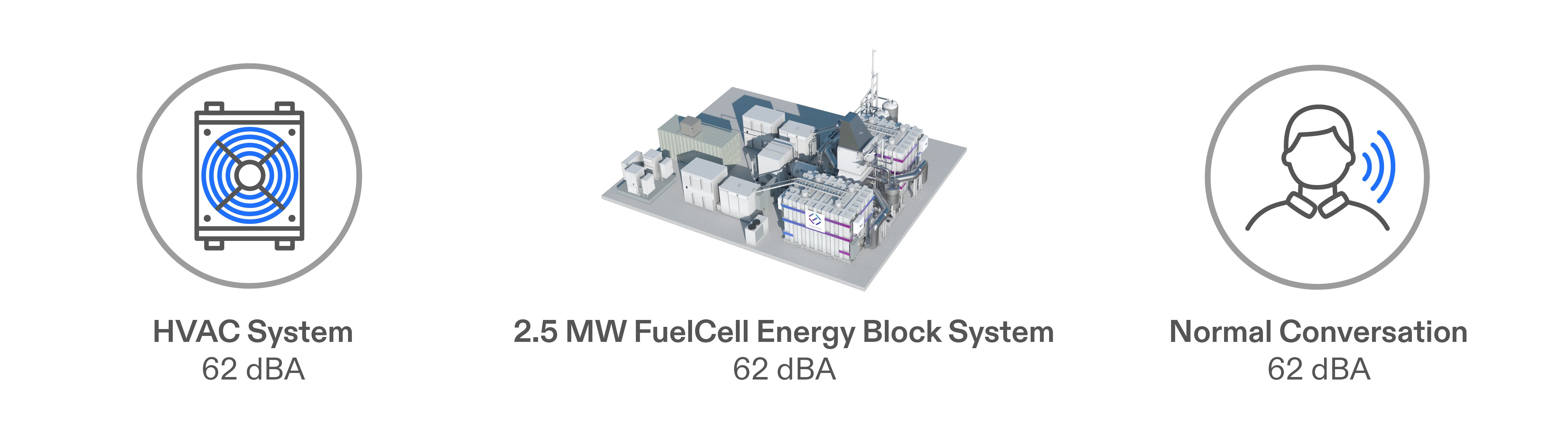 This level is widely regarded as safe for continuous, long-term exposure, does not require hearing protection, and does not interfere with speech or daily activities.
Why quiet operation matters for urban and community settings
For data centers located near residential areas, hospitals, universities, or mixed‑use developments, noise can be a limiting factor. Loud generation equipment may require setbacks, sound walls, or restricted operating hours.
FuelCell Energy Block Systems enable continuous on-site power (even at night) without introducing disruptive industrial noise. The quiet operation supports smoother permitting, fewer community concerns, and greater flexibility in site selection, especially in space‑constrained or noise‑sensitive environments.
Quiet fuel cell operation helps data center power scale
The FuelCell Energy Block System’s quiet operation can also be a scaling advantage. As data centers expand, adding more generation assets can quickly compound noise and potentially trigger additional studies, mitigation, and tighter constraints on where equipment can be placed. Because carbonate fuel cell systems maintain a low, steady sound profile, operators can add capacity in phases with fewer acoustic surprises and less reliance on large enclosures, sound walls, or oversized setbacks.
Quieter power supports higher site density and repeatable deployment across multiple buildings or campuses—helping meet growing load without increasing disruption for neighbors, tenants, or on‑site staff. That makes quiet on‑site generation easier to standardize as a long-term power strategy, rather than a one‑off exception.
Quiet data center power that belongs anywhere
As data centers continue to move closer to people, quiet operation is no longer optional. FuelCell Energy’s carbonate fuel cells can deliver reliable power with a sound profile comparable to everyday environments, not heavy industry.
Contact us today to learn more about FuelCell Energy’s technology solutions.
.png?width=1037&height=559&name=fce-data-center-whitepaper-graphic%20(1).png)